By its “sheen.” This is what a septic tank service guy told my friend in Florida when he thought his backyard tank was overdue. “Ya’ll don’t really need a pump,” the septic man said in his blue-gray coveralls. My friend was unsure: his neighbors needed their septic tanks pumped every few years. Inspecting the filter, the man asked, “You guys vaygans?”
“How did you know that?” My friend asked, incredulous. The septic savant explained there was a certain “sheen” on the filter, and a unexpectedly low volume of solids in the tank. Evidently, he had been in the business long enough to identify an herbivorous household by its relatively benign fecal sludge.
While there isn’t much research corroborating this remarkable anecdote, we know empirically that plants decompose sooner than animals. This is why some compost systems exclude meat, and why fallen leaves often disintegrate into soil by spring.
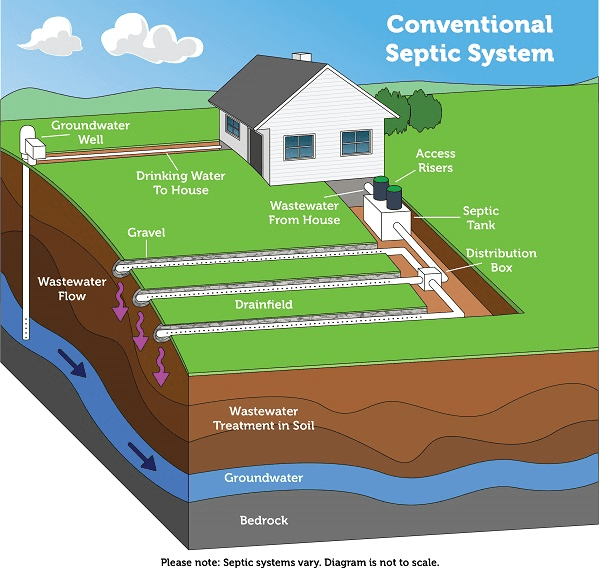
Decomposition is accomplished largely by microbes, and the microbiology of septic waste appears to be a rigorous science. Per Maine’s Department of Health, “the microbes associated with septic systems are bacteria, fungi, algae, protozoa, rotifers, and nematodes.” Anaerobic bacteria are responsible for the initial metabolism of fresh slop inside a tank. Then, as thinner effluent leeches into the drain field under your backyard, more complex microbes feast until the treated water disperses into the ground.
In the case of my Florida friend’s shimmering cesspool, the anaerobic digestion was efficient enough to minimize solid waste. Where did such quality bacteria come from? Necessarily it came from my friend and his family’s colons. Some combination of their diet and consequent gut microbiota had optimized digestion downstream of the toilet.
There are many variables here, and experiments would have to be done to establish causality. But considering the service man’s experience and what we do know about human waste, is there any better testament to the plant-based advantage than a healthy septic tank?
 herbivores.life